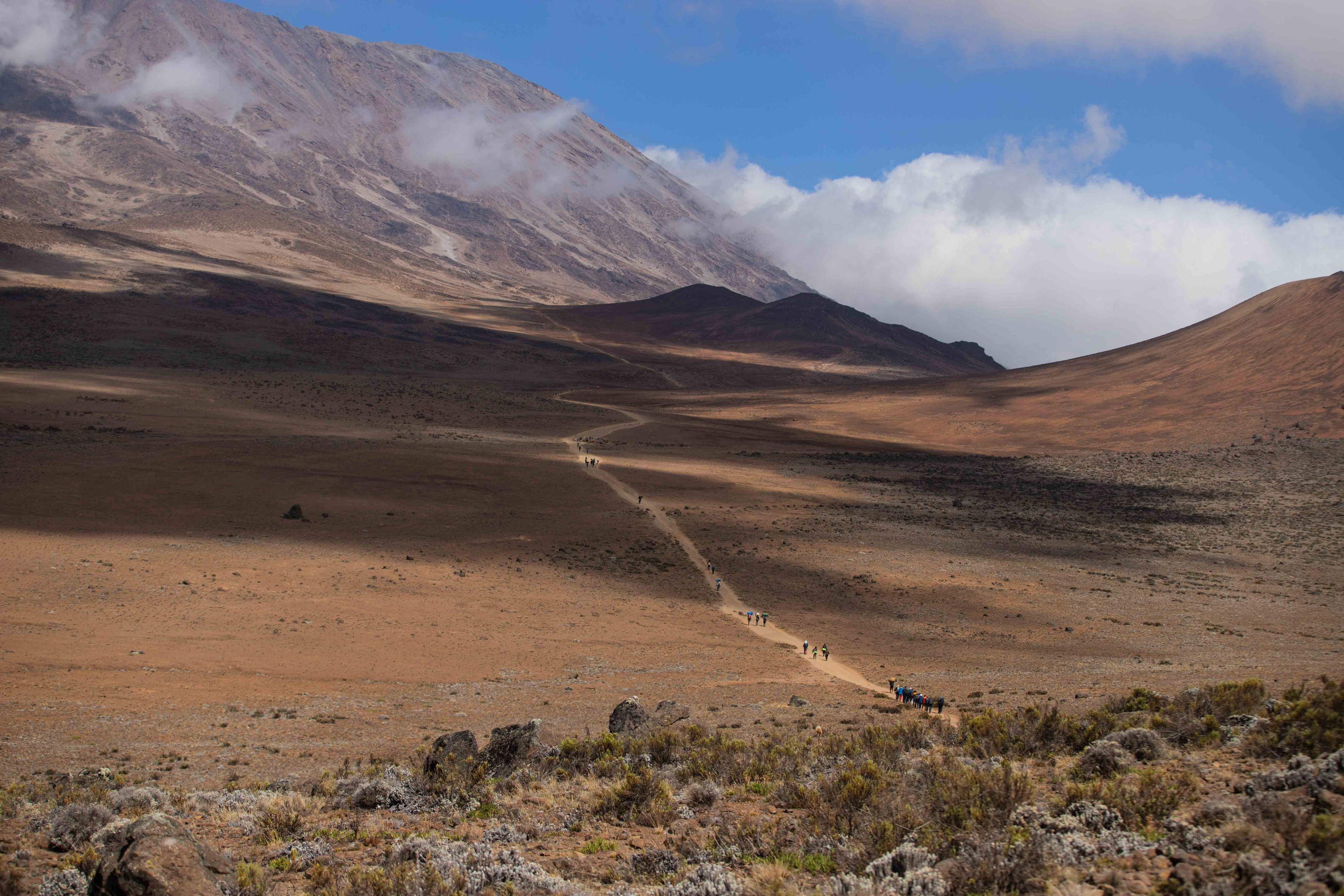
A dusty trekking path winds through the barren alpine desert zone of Mount Kilimanjaro.

{ Tour }

Marangu Route: Five Days, and Why It Isn’t the Easy Way

Kilimanjaro's Marangu Route in five days, hut-based throughout: the most comfortable option, and honestly the one with the lowest summit success rate.

Duration5 Days / 4 Nights
Group size2 – 10 climbers
Best monthsJune – October and December – February
From$2,280 per person sharing, including park fees

{ 01 }

The Trip in Short

Marangu is the only Kilimanjaro route with hut accommodation the whole way, and the only one you can walk in five days rather than six or more. Both of those facts make it popular. Neither of them makes it a good idea if summiting matters more to you than convenience.

The short schedule leaves far less time to acclimatise than routes like Lemosho or Machame, and success rates on the five-day Marangu itinerary are meaningfully lower as a result: something worth knowing before you book on price alone. We run it because some travellers genuinely prefer huts to tents and accept the trade-off with their eyes open; we would rather tell you that than sell you the cheaper option quietly.

Park fees and rules on the Tanzanian mainland are set by Tanzania National Parks (TANAPA).

Highlights

  • Hut accommodation the entire route, no tents required
  • Rainforest, moorland and alpine desert in five days
  • Kibo and Mawenzi peak views from Horombo Hut
  • Midnight summit push to Uhuru Peak via Gilman's Point
  • Shortest and least expensive standard Kilimanjaro itinerary
  • Honest guidance on realistic summit odds before you book

{ 02 }

Where You Go, Stop by Stop

1
Day 1
Marangu Gate to Mandara Hut
2
Day 2
Mandara to Horombo Hut
3
Day 3
Horombo to Kibo Hut
4
Day 4
Summit attempt, descend to Horombo
5
Day 5
Descend to Marangu Gate

{ 03 }

Day by Day Itinerary

Day 1: Marangu Gate to Mandara Hut

A gentle three to four hour walk through montane rainforest, past blue monkeys and the occasional colobus, to Mandara Hut at 2,700 metres.

Day 2: Mandara to Horombo Hut

The forest thins into heath and moorland on a longer five to six hour day, with Kibo's ice cap and Mawenzi's jagged ridgeline both visible from Horombo Hut at 3,720 metres.

Day 3: Horombo to Kibo Hut

Climbing out of vegetation entirely into alpine desert, a stark, dry landscape leading to Kibo Hut at 4,700 metres. Note that there is no rest day built into this five-day schedule, one of the main reasons its success rate trails the longer routes.

Day 4: Summit Night and Descent

A midnight departure for Gilman's Point on the crater rim, then on around to Uhuru Peak at 5,895 metres if conditions and fitness allow, followed by a long descent all the way back down to Horombo Hut the same day.

Day 5: Descend to Marangu Gate

A final few hours back through the forest to the gate, where certificates are issued before the transfer to your hotel.

{ 04 }

What the Price Covers

Included

  • Kilimanjaro National Park fees and rescue fees
  • Hut accommodation for the duration of the climb
  • Mountain guides, porters and cook
  • All meals on the mountain
  • Airport transfers in Moshi or Arusha
  • Oxygen and basic first-aid kit carried by guides

Not included

  • International flights and visas
  • Travel and medical insurance, including evacuation cover
  • Personal climbing gear and clothing hire
  • Tips for guides, porters and cook
  • Sleeping bag hire where needed

{ 05 }

Before You Book

How much lower is Marangu's success rate, honestly?

Without a built-in acclimatisation day, five-day Marangu climbs see meaningfully lower summit rates than the eight-day Lemosho or Machame routes: we can quote current operator figures on request, and would rather you knew this before paying than after failing to summit.

Can I add a sixth day for acclimatisation?

Yes, and we recommend it: a six-day Marangu with a rest day at Horombo materially improves the odds for a modest extra cost.

Are the huts comfortable?

Basic bunk-style huts with shared rooms, no heating, and squat toilets: comfortable relative to a tent, not comfortable by hotel standards.

What is included in the park fees?

Kilimanjaro's daily conservation, camping/hut and rescue fees typically make up $1,000–$1,200 of the total climb cost, regardless of route.

{ Enquiry }

Plan this safari

A tailor-made safari

Tell us a little about your group and dates. A planner replies within one working day, and there is no deposit to enquire.