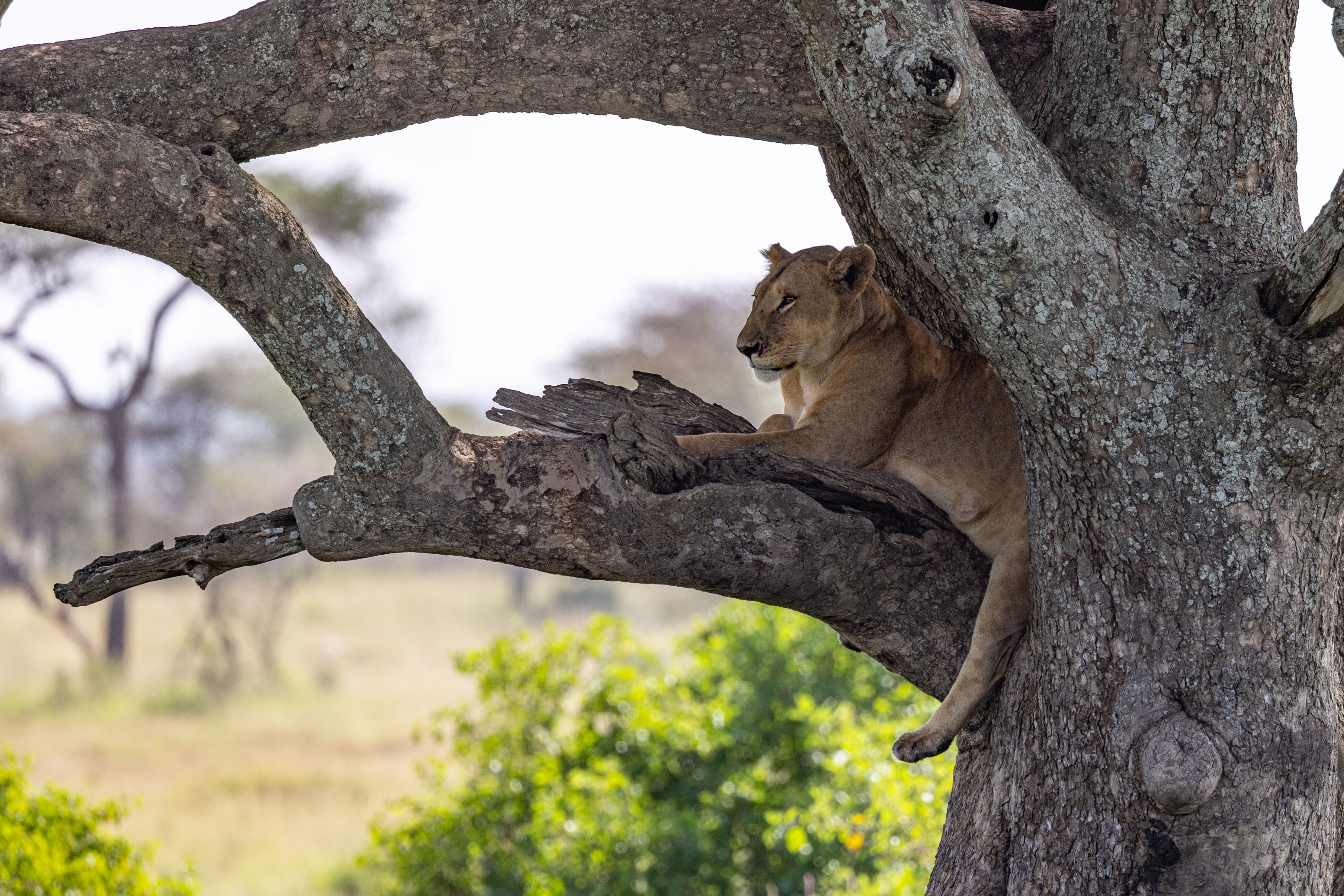
The Big Five, lion, leopard, elephant, buffalo and rhino, is a name from the era of hunting licences, when these five were considered the most dangerous to track on foot. It has outlived that meaning and become shorthand for a good day out, though a guide who has spent years in these parks will tell you the list undersells at least half the wildlife around it.
Deciding which parks to prioritise for which animal is a genuinely useful exercise, because no single park does all five equally well, and a route built around the full list looks different from one built around just lion and elephant.
Lion
Lions live in prides, spend most of the day resting in shade, and hunt mostly at dawn, dusk or night, which is why a game drive timed early or late tends to find them active rather than asleep. Queen Elizabeth National Park in Uganda is known for the tree-climbing lions of Ishasha, a local habit rather than a different subspecies. The Maasai Mara and Serengeti hold larger, more visible prides, especially along the rivers during the migration months.
Lion prides defend a territory as a group, and cubs are raised communally within it, which is part of why a good sighting often means several animals at once rather than a lone individual. Listening for contact calls at dusk, a deep, carrying roar, is often how a driver-guide narrows down where to look the next morning.
Leopard
Solitary, mostly nocturnal, and the hardest of the five to find on purpose. Leopards favour riverine forest and thick cover, often draping a kill over a tree branch out of reach of hyenas. Queen Elizabeth and the Serengeti’s Seronera area both have healthy, if elusive, populations. A sighting here is more luck and a sharp-eyed driver-guide than a guaranteed outcome.
A leopard’s spotted coat, rosettes rather than solid spots on close inspection, breaks up its outline against dappled light almost perfectly, which is exactly the problem for anyone trying to spot one. Scanning tree branches and the shaded base of thickets, rather than open ground, is usually the more productive habit.
Elephant
The easiest of the five to see well, elephants move in family herds led by an older matriarch, and a herd crossing a road or drinking at a waterhole is one of the more reliable safari moments. Amboseli in Kenya is known for large herds against a Kilimanjaro backdrop, Tarangire in Tanzania for concentrations around its river in the dry season, and Murchison Falls in Uganda for herds along the Nile.
Bulls, meanwhile, often travel alone or in small bachelor groups once they leave the family herd, and a lone old bull, sometimes called an “askari” locally, standing near a waterhole is a familiar sight on its own. Elephants communicate over long distances using low-frequency rumbles that carry through the ground as much as the air, a detail worth knowing even though you will not hear it yourself.
Buffalo
Cape buffalo move in large herds, sometimes numbering in the hundreds, and are considered one of the more unpredictable animals to encounter on foot, which is part of why walking safaris keep a respectful distance. They are common across nearly every savannah park in the region, from Lake Mburo to the Serengeti, and rarely take long to find.
Old, solitary bull buffalo, pushed out of the herd and often bad-tempered as a result, are considered among the more genuinely dangerous animals to encounter on foot, more so than lion in some rangers’ experience, which says something about treating the whole list with equal caution rather than singling out the obvious predators.
Rhino
Rhino sightings take more planning than the other four, because populations are smaller and more concentrated. In Uganda, the only place to see rhino is Ziwa Rhino Sanctuary, a dedicated sanctuary for southern white rhino near Murchison Falls, reached on a guided tracking walk rather than a vehicle game drive. In Kenya, Lake Nakuru National Park and Ol Pejeta Conservancy hold both black and white rhino. Ngorongoro Crater in Tanzania has a small population of black rhino visible from the crater floor, and Akagera National Park in Rwanda has reintroduced both black and white rhino after years of local extinction.
Read about Ziwa Rhino Sanctuary or the rhino tracking experience there.
What the List Leaves Out
Hippo, giraffe, cheetah, hyena and the various antelope species rarely make anyone’s must-see list on paper, yet they fill most of a real day’s sightings and often produce the more memorable moments, a cheetah scanning from a termite mound, a giraffe crossing a road at an improbable angle. Treating the Big Five as a checklist to complete rather than a starting point tends to make for a better trip, not a worse one.
Watching Well
The best sightings tend to come from patience rather than pursuit: staying at a respectful distance, letting the driver-guide read the animal’s body language, and not asking for the vehicle to get closer than it already is. Good etiquette also makes for better photographs, since a relaxed animal behaves naturally and a stressed one does not.
None of the Big Five live in only one country, which is exactly why a cross-border itinerary can work so well. Tell us which parks interest you and we will build a route around them.