
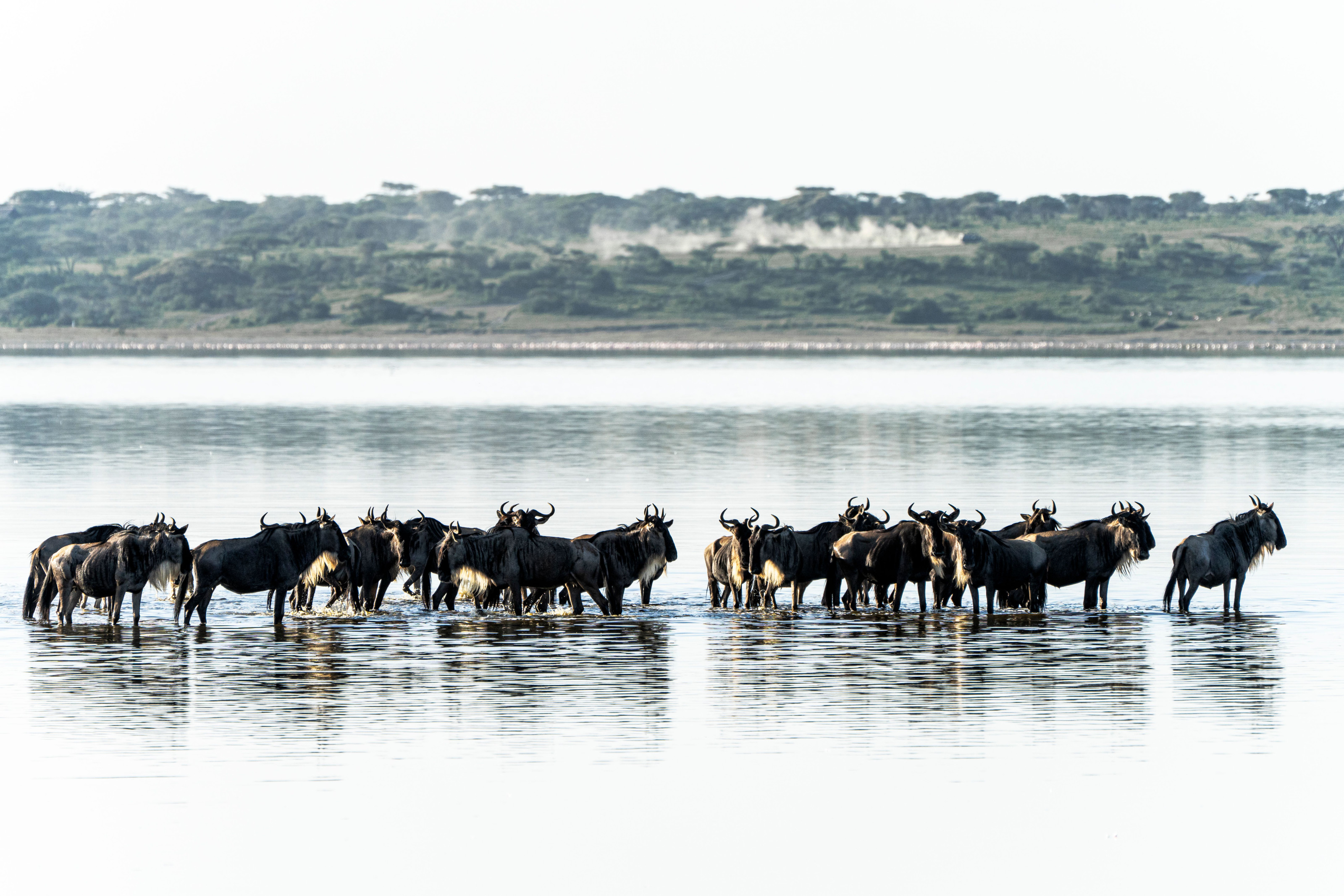
What is actually migrating
The Great Migration is the year-round, clockwise movement of over 1.5 million wildebeest, more than 200,000 zebra and roughly 300,000 Thomson’s gazelle across the Serengeti-Mara ecosystem, a single continuous landscape that straddles the Tanzania-Kenya border. It is not one event. It is a permanent, slow-moving circuit driven by rainfall and grass growth, and different parts of it happen in different places at different times of year.
The circuit, roughly month by month
January to March: calving season
The herds concentrate on the short-grass plains of the southern Serengeti, around Ndutu, where several hundred thousand calves are born within a few weeks — one of the most concentrated predator-prey events anywhere in Africa, since a newborn wildebeest is on its feet within minutes but still an easy target.
April to May: the long rains push them north
As the southern plains dry out and the long rains move north, the herds follow, passing through the central Serengeti in long, strung-out columns.
June to July: the western corridor
The migration reaches the Grumeti River in the western Serengeti, where the first river crossings of the year happen — smaller and less famous than the Mara crossings, but crossings nonetheless, complete with the same crocodile-infested tension.
August to September: the Mara River crossings
This is the period most people picture: herds massing on the banks of the Mara River, crossing between the northern Serengeti and Kenya’s Maasai Mara, and back again, sometimes more than once, as they respond to grazing conditions on either side.
October to December: the return south
The short rains arrive and the herds drift back south through the Lobo area and Loliondo, eventually returning to the southern plains in time for the next calving season.
Why no one can promise a crossing
A river crossing happens when a critical mass of animals decides, on that particular day, that the grazing on the other side is worth the risk of predators and the current. That decision is made by the herd, not by a park ranger or a tour operator, and it can happen in the middle of the afternoon or not at all for a week. Guides who have watched the migration for twenty years will tell you honestly: some visitors see three crossings in three days, others spend a week in the right location during the right month and see none. Anyone who guarantees a crossing is guessing, not promising.
What actually improves your odds
- Staying multiple nights, not one, near a known crossing point during August or September — a single day’s visit is a coin flip, four or five days is genuinely better odds.
- Using a guide based in a private conservancy who tracks herd movement daily and can reposition you accordingly, rather than a single fixed-camp itinerary.
- Accepting that the “safest” months statistically — peak August to September — are also the busiest and most expensive, and that a crossing seen in July or October is no less real for being less crowded.
What you’ll see even without a crossing
The migration is not only the crossing footage everyone has watched online. Long columns of wildebeest stretching to the horizon, the calving grounds thick with newborns and the predators that follow them, and the sheer scale of that many animals moving together are all part of the same event, visible across most of the year somewhere in the ecosystem. A trip built around “seeing the migration” broadly, rather than “seeing a crossing” specifically, is much harder to disappoint.
The Kenyan side of the same story
Because the Serengeti and the Maasai Mara are one continuous ecosystem split by an international border, the herds that cross the Mara River are the same herds regardless of which side you’re watching from. Kenya’s conservancies bordering the reserve often offer a quieter, less crowded vantage on the same crossings that draw large numbers of vehicles on the Tanzanian side, since conservancy land typically caps visitor vehicle numbers far more tightly than the open reserve does.
A hot-air balloon view
For travellers who want to see the migration’s scale rather than wait at a single crossing point, a sunrise hot-air balloon safari over the Serengeti or Mara — typically $450–600 per person for about an hour in the air, followed by a champagne breakfast set up in the bush — gives a genuinely different perspective on just how far the herds stretch, often revealing columns and groupings invisible from ground level in a vehicle.


