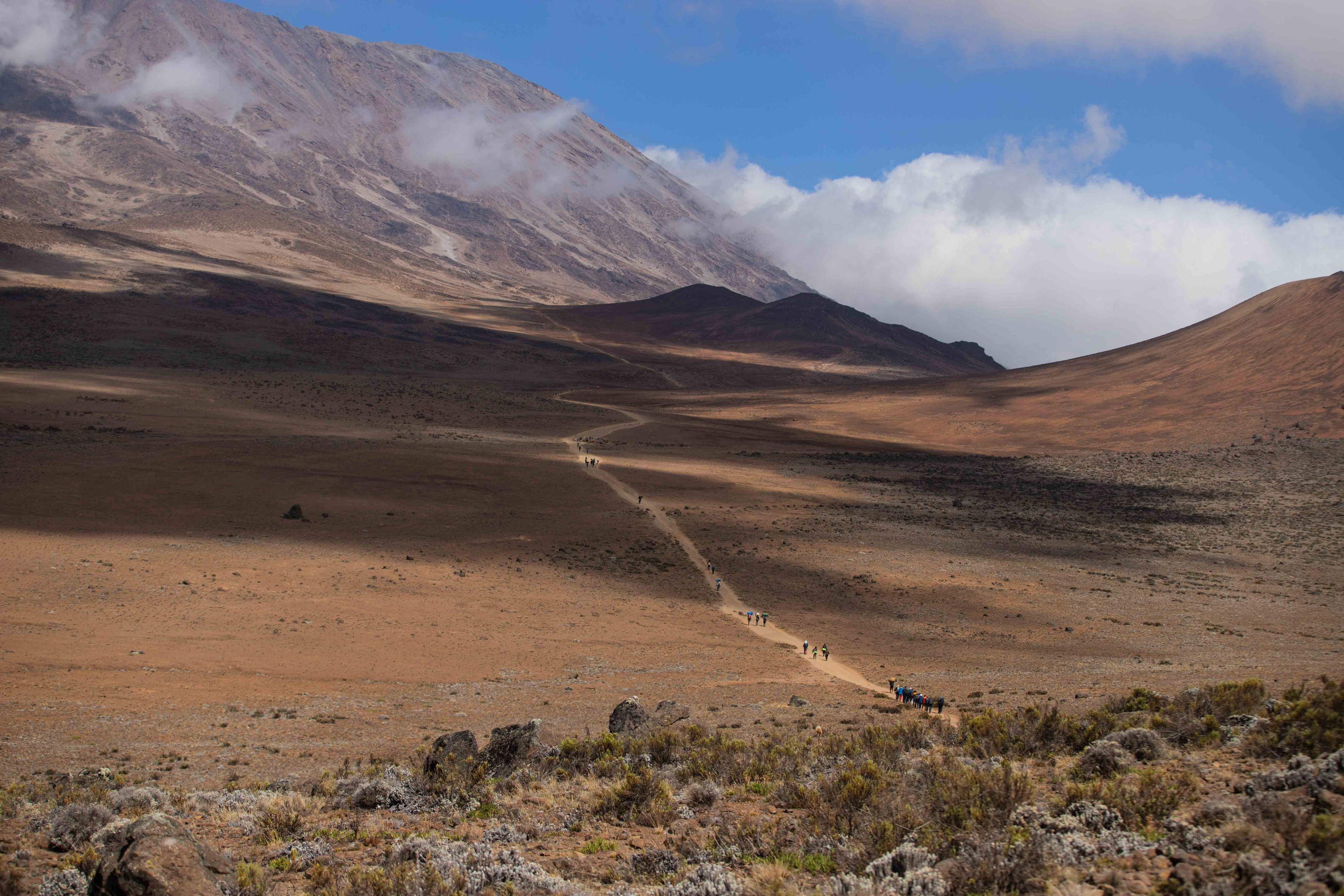
Clouds drift below the snow-capped summit of a towering volcanic peak seen from above.

{ Experience }

Climbing Kilimanjaro

A six to nine day trek up Africa's highest peak through five climate zones, no technical climbing skill required but genuine altitude challenge.

Duration6–9 days depending on route
WhereMount Kilimanjaro, Tanzania
ExertionChallenging
From$2,200

{ 01 }

The Experience

Kilimanjaro is a walk, not a climb, in the technical sense — no ropes or crampons on the standard routes — but that description undersells what six to nine days and 5,895 vertical metres actually demand. The mountain rises through five distinct climate zones, from cultivated farmland through rainforest, moorland, alpine desert and finally arctic summit conditions, each with its own weather and its own toll on the body.

Six routes are commonly used, each trading off scenery, crowding and acclimatisation time: Marangu, the only route with hut accommodation, is often called easiest logistically but has one of the lower summit success rates due to its compressed schedule; Lemosho and the Northern Circuit take longer and acclimatise better, with correspondingly higher success rates; Umbwe is the steepest and least forgiving.

Park fees and rules on the Tanzanian mainland are set by Tanzania National Parks (TANAPA).

Highlights

  • 5,895m summit, Africa's highest point
  • Six established routes with different lengths and success rates
  • Five distinct climate zones from farmland to arctic summit
  • Summit night typically begins around midnight for a sunrise arrival
  • No technical climbing gear required on standard routes
  • Full porter, guide and cook support throughout

{ 02 }

How the Day Unfolds

Rainforest to moorland

The first two days climb through dense montane rainforest, often wet and muddy underfoot, home to colobus monkeys and turacos, before breaking out into heather and moorland zone as the trees thin and views open up over the surrounding plains.

Alpine desert and acclimatisation

Days three to five or six, depending on route, move through stark alpine desert — sparse vegetation, strong sun, cold nights — with most itineraries building in a deliberate high-camp, lower-sleep acclimatisation day to help bodies adjust to thinning air before the final push.

Summit night

The final ascent typically starts around midnight from high camp, climbing loose scree in the dark and cold, often well below freezing, aiming to reach Uhuru Peak around sunrise. This is the hardest single stretch of the climb — slow, exhausting, and where altitude affects people unpredictably regardless of general fitness.

Descent

After time at the summit for photos, the group descends rapidly, often reaching a lower camp the same day, before a final one or two days' walk back down through the climate zones to the gate, considerably faster than the ascent.

{ 04 }

Included, and What to Bring

Included

  • Park fees and camping/hut fees
  • Professional mountain guides and porters
  • All trek meals
  • Group camping or hut accommodation
  • Airport and trailhead transfers

Bring

  • Layered clothing for five climate zones, from t-shirt to down jacket
  • A sleeping bag rated to at least -10°C
  • Sturdy, worn-in hiking boots
  • Trekking poles
  • A head torch for the summit night ascent
  • Altitude sickness medication, discussed with a doctor beforehand

{ 05 }

Permits and Good to Know

Kilimanjaro National Park fees run to roughly $1,000–1,200 of a climb's overall cost, covering park entry, camping or hut fees and rescue fees, bundled by operators into an all-inclusive package price rather than paid separately by the climber.

Do I need climbing experience?

No technical climbing skill is required on the standard tourist routes — this is a long, high-altitude walk, not a technical ascent, though it should not be underestimated.

Which route has the best success rate?

Longer routes with more acclimatisation days — the Northern Circuit and Lemosho in particular — generally show meaningfully higher summit success rates than shorter routes like Marangu.

How serious is altitude sickness risk?

Genuinely serious — this is the main reason climbs fail, more than fitness. A longer, better-acclimatised route materially improves your odds.

Is a tip expected for porters and guides?

Yes, tipping porters, guides and cooks is standard practice and a meaningful part of the local economy around the mountain; your operator should provide guidance on appropriate amounts.

{ Enquiry }

Plan this safari

A tailor-made safari

Tell us a little about your group and dates. A planner replies within one working day, and there is no deposit to enquire.